Kickoff
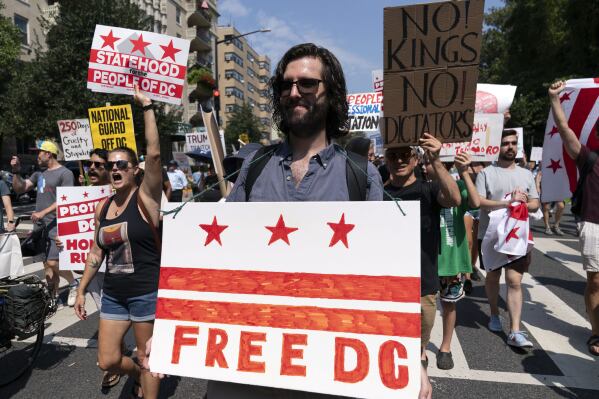
In early September, several thousand Washington D.C. residents marched towards the White House in protest of his controversial executive order which deployed National Guard troops in the nation’s capital. With their long history of progressive politics and support for social justice initiatives, residents of Washington, D.C. endured the brutal afternoon heat to voice their opposition not only to the recent military occupation, but the President’s policies more broadly. Many pundits on “The Left” have accused the Trump administration of eroding democratic institutions, empowering oligarchic power structures, and manipulating social and ethnic tensions to enact increasingly xenophobic policies that target vulnerable communities. I was one of those marchers — thrilled to stand among so many lively, determined protesters — yet I couldn’t shake my feelings of defeat and disgust at what the United States had become since Trump took office. When talking about my home country to my friends overseas, I felt shame and embarrassment.
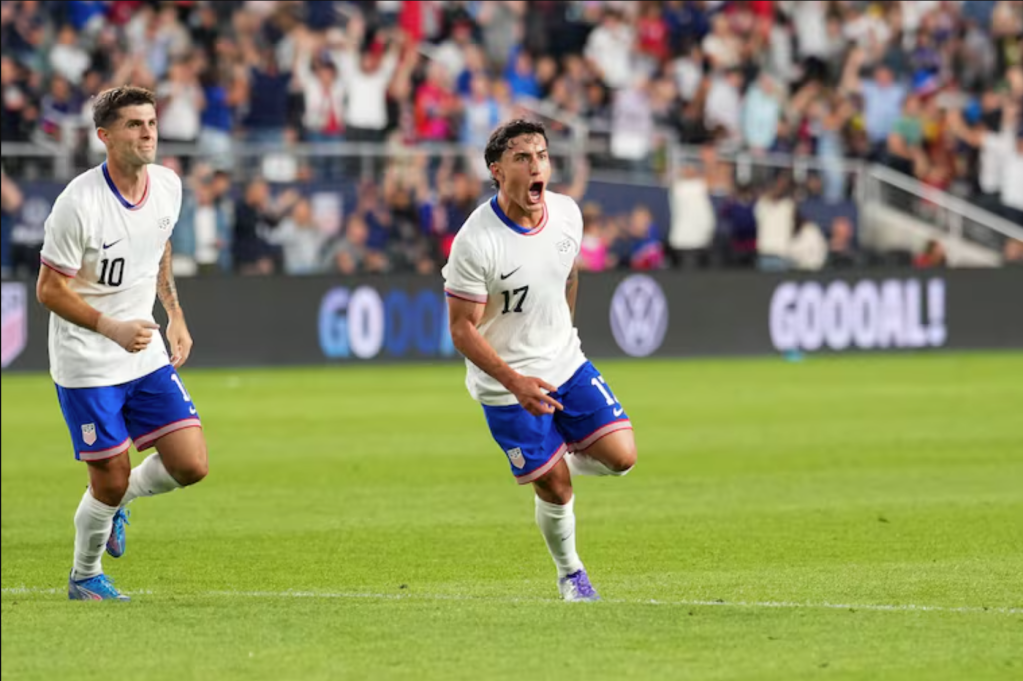
Fast forward three days. The United States men’s national soccer team (USMNT) is facing off against Japan. I’m leaning forward on the sofa in the living room, eyes glued to the TV while clutching my replica 1994 “denim stars and stripes” USA World Cup jersey. On paper, this is an exhibition game (known as “friendlies”); however, the USMNT has been in poor form, having lost the previous five matches against top-25 ranked national teams, and not winning a match against a top team in almost 18 months. This team is preparing for a milestone World Cup in the United States that will determine the direction of “the beautiful game” in the United States. Results need to improve for USA fans to be able to dream of a deep tournament run this summer. After thirty minutes, Max Arfsten darts down the left flank and swings a cross onto the volleying left foot of Alejandro Zendejas. I stand in and pump my fist in the air as the ball hits the back of the net. As Folarin Balogun scores a second to put the finishing touches on yet another “dos-a-cero” victory in Columbus, I am satisfied and encouraged by the performance. We finally seem to have found a formation that works, and our players are starting to click. For the first time in a while, I feel a rare sense of patriotism, pride, and hope toward a representation of the United States.
Given my political leanings, the sociopolitical state of the US, and the perceived unlikeability of the USMNT, it seems unlikely I would be such a fan of Team USA. However, in the USMNT, I see an inspiring narrative of a young, diverse group of talented, inspired athletes who can not only inspire a generation of Americans to buy into soccer but also provide a roadmap for how we can function—and succeed—together as a nation, drawing upon the best aspects of our shared identity.
In this first edition of Explaining Offsides I will provide three reasons why politically progressive sports fans, in particular, should back the Red, White and Blue at next summer’s World Cup in the United States.
Tattooed Millionaires
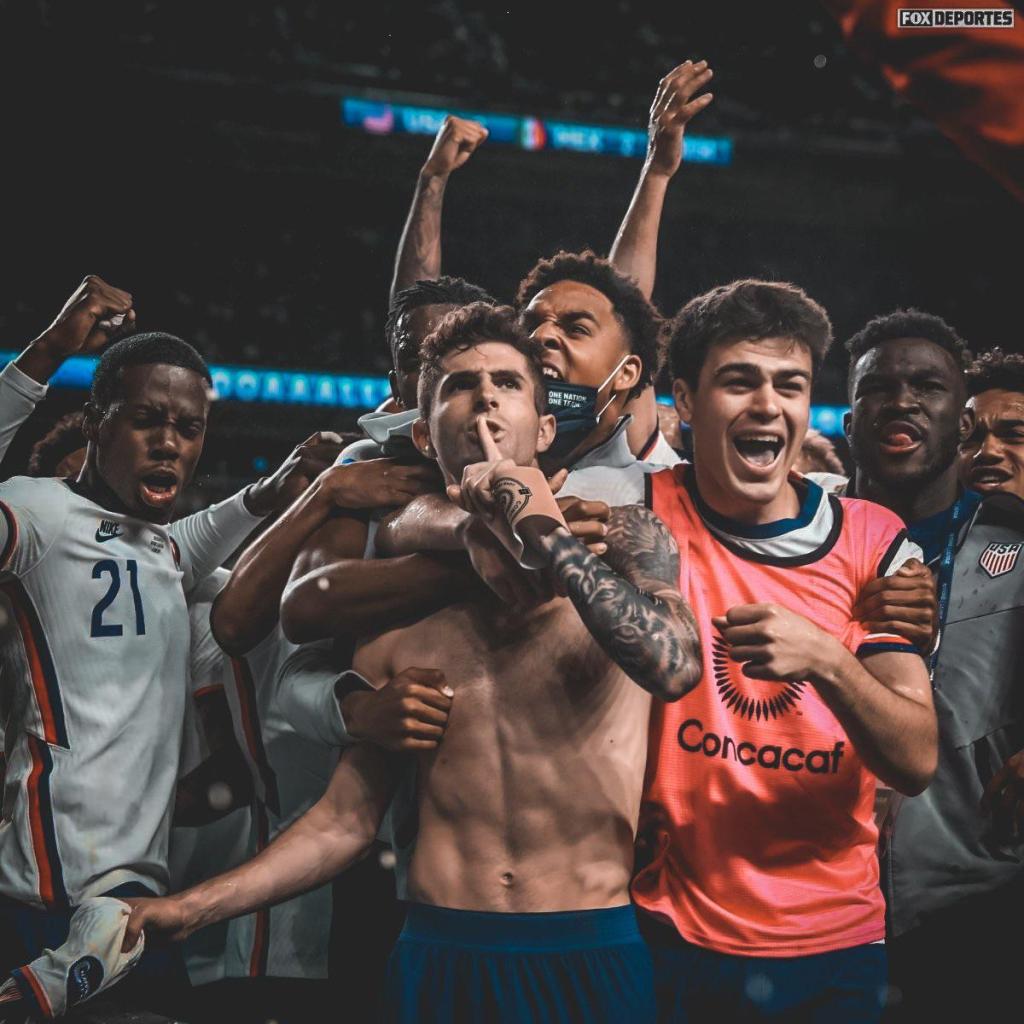
Many USMNT fans have felt disenchanted with the squad as of late. In the 2000s, the men’s team had a reputation for playing with grit, passion, and pride. What they lacked in comparative talent, they made up for with their unity and seeming willingness to run through walls for Team USA. In the wake of the USMNT’s monumental failure to qualify for the 2018 World Cup, a generation of young talent sprouted with stars like Christian Pulisic, Timothy Weah, and Weston McKennie breaking out at some of the best European clubs in the world. Most observers would likely state that the current American talent pool is the best that it’s ever been. Yet something appears to be missing. They only qualified for the 2022 World Cup on goal difference, their performance in Qatar was mixed, they were embarrassingly eliminated in the first round of the U.S.-hosted Copa America in 2024, they failed to win the 2023 and 2025 Gold Cups (the North American championships), and they were frankly humiliated multiple times over the last few months by the likes of Switzerland, Canada, and Panama. In recent years, the USMNT has lacked that same level of spirit. Worse yet, these new soccer superstars have come across as unlikeable, particularly after an infamous summer when several key players declined to play in the Gold Cup, leading to mass condemnation by fans who implied that the current crop of players “don’t care enough” about playing for the Stars and Stripes. This led to a series of public jabs exchanged between USMNT squad members, the media, and former team legends. This has contributed to an image of a team full of spoiled, overpaid pushovers or—as Lalas once famously quipped—“soft, tattooed millionaires.”

Some politically progressive fans have felt conflicted about getting behind this team enthusiastically given the current political pariah status of the United States and recent minor political controversies involving the USMNT’s star player Christian Pulisic. The “LeBron James of Soccer” sparked an uproar when he celebrated a goal against Jamaica by performing the infamous “Trump dance” just days after Trump’s election victory over Kamala Harris. Pulisic claimed that the dance was not political in nature and just a trend that he followed because he “thought it was funny.” Earlier in 2021, he was caught liking a Seth Jahn Instagram post in which the conservative former Paralympian posed with a room of guns and appeared to call for the killing of Antifa members. It’s important to note that Pulisic is a generally shy public figure, and he has never publicly declared a political preference. However, these incidents have caused left-leaning USMNT fans to be more hesitant to back the AC Milan forward.
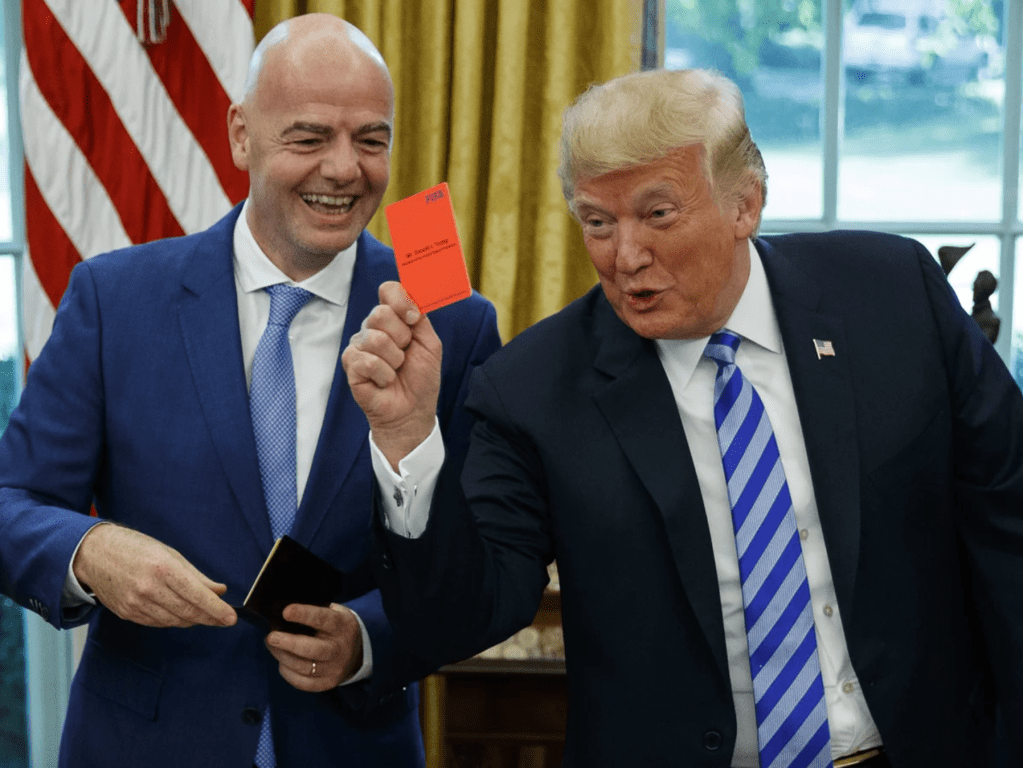
Finally, many non-conservative Americans find it difficult and perhaps even inappropriate to express any sense of pride or patriotism for the United States at this moment in history. The Trump administration has made an active effort to tie the U.S. president to the World Cup. Over the summer, Trump crashed the podium and wouldn’t leave the stage after handing Chelsea FC the Club World Cup trophy. He then proceeded to take that trophy from Chelsea and display it in the White House. He dragged the Juventus team to the White House during their US tour with photos of USMNT stars Timothy Weah and Weston McKennie looking as if they wished they were literally anywhere else. Despite Trump’s recent threats to move games away from host cities that he deems “disloyal,” FIFA President Gianni Infantino is a frequent and public visitor to the White House who gifted Trump a set of red and yellow cards, joking that the president could “use them on his critics.” With the World Cup having the MAGA stench tied to it, visa restrictions making it difficult for potential fans to travel to the World Cup, and of course the anti-immigrant rhetoric and forced disappearances that bombard the news, supporting anything “USA-branded” can be met with hesitancy, unease, and even shame for some. However, Americans who feel uncomfortable supporting the USMNT at this moment should fully back the Red, White, and Blue by the time of Team USA’s opening game on June 12 in Los Angeles because. . .
Reason 1: The USMNT is more likable than one might think.
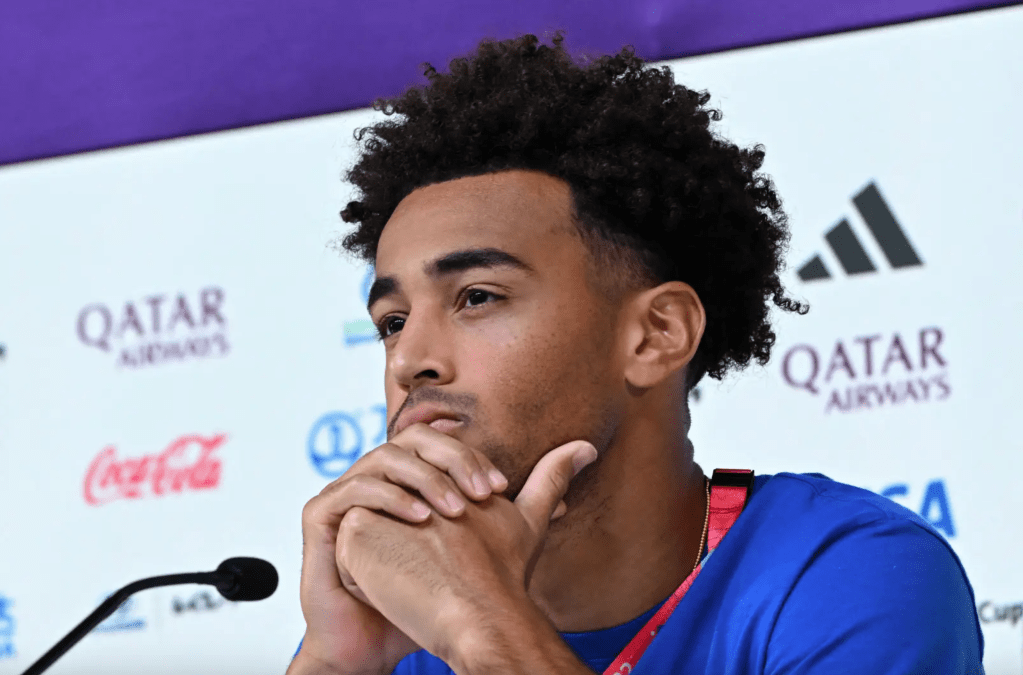
In the press conference before the USA’s must-win match against Iran at the 2022 World Cup, team captain Tyler Adams pronounced the opposing nation’s name as “I-RAN,” a classic American pronunciation error (it should be pronounced “ih-rahn”). The next question came from an Iranian reporter who corrected Adams’ pronunciation and followed up with a question that essentially asked how Tyler, who is of African American descent, could represent a country with such an ugly history of discrimination against people of color. Given the politically charged nature of this matchup, many have since stated that this question was prompted by U.S. criticism of the Iranian government’s handling of the then-ongoing Mahsa Amini protests and their general treatment of women who have only recently been allowed to attend sporting events. Tyler immediately apologized for his mispronunciation and then responded with great poise, calm, and character:
“One thing that I’ve learned, especially from living abroad in the past years and having to fit in in different cultures, is that in the U.S., we’re continuing to make progress every single day. I grew up in a white family with obviously an African American heritage and background as well. So I had a little bit of different cultures, and I was very easily able to assimilate in different cultures. Not everyone has that ease and the ability to do that. And obviously it takes the longest to understand. And through education, I think it’s super important—like you [the reporter] just educated me now on the pronunciation of your country. So it’s a process. I think as long as you see progress, that’s the most important thing.”
Tyler Adams, US Captain at the 2022 FIFA World Cup
I don’t believe that the majority of our elected officials, regardless of political affiliation, are capable of answering such a charged question with the same amount of class, elegance, and emotional intelligence that the then-23-year-old Leeds United defender from White Plains, NY demonstrated. His response was succinct, thoughtful, respectful, and it defused a political land-mine of a question. While it isn’t fair to ask professional athletes to serve as diplomats, and though I don’t personally believe that athletes should be required to use their platforms to promote political messages if they aren’t comfortable doing so, many American footballers and the USMNT as whole have used their platforms to promote philanthropic initiatives and even take firm progressive stands on key societal issues. Because soccer in the United States has a long history of being embraced by immigrant and marginalized communities, soccer culture in the U.S. has frequently taken progressive stances on social justice causes.
On the issue of LGBTQI+ rights, the 2022 US World Cup squad hung a banner at their Ar-Rayyan practice facility featuring the USMNT crest with rainbow stripes to protest Qatar’s anti-LGBTQ+ laws. At the 2016 Copa America, then-USMNT captain Michael Bradley wore a rainbow armband in honor of the victims of the Pulse Nightclub shooting in Orlando. Three years ago, U.S. Soccer partnered with the You Can Play Project to auction off pride-themed signed jerseys in order to raise funds to support LGBTQ+ inclusion in sports, and the national team has frequently worn pride-colored jerseys at matches during Pride Month over the years. Furthermore, when former USMNT player Robbie Rogers came out of the closet in 2013, many USMNT players stepped up to express their support. Former USMNT defender Eddie Pope tweeted, “Brave men like you will make it so that one day there is no need for an announcement.” Omar Gonzalez and A.J. De LaGarza took it a step further by joining several of Rogers’s L.A. Galaxy teammates to work with Athlete Ally in order to provide Robbie the support and resources needed to navigate his new life as an “out” athlete.
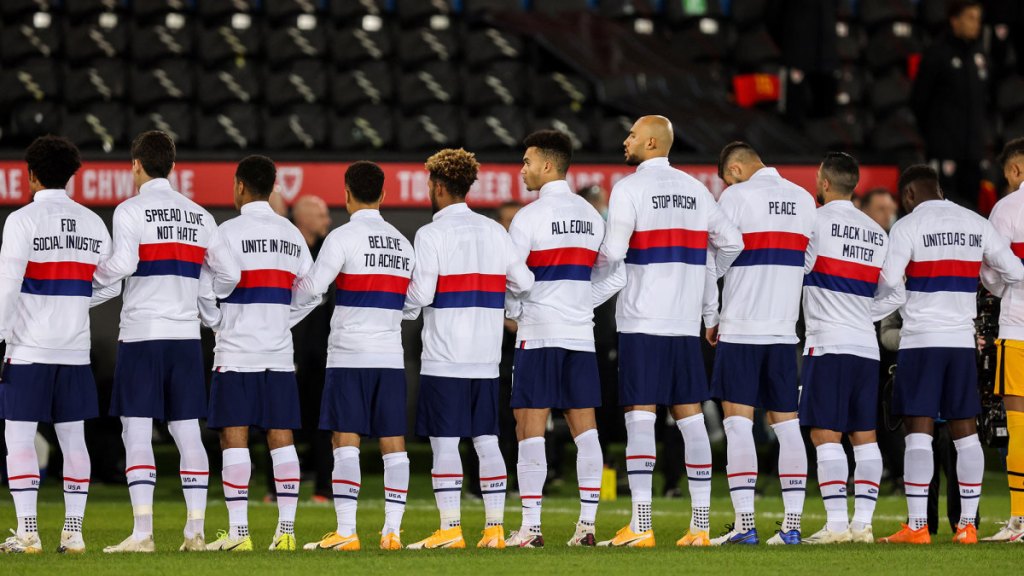
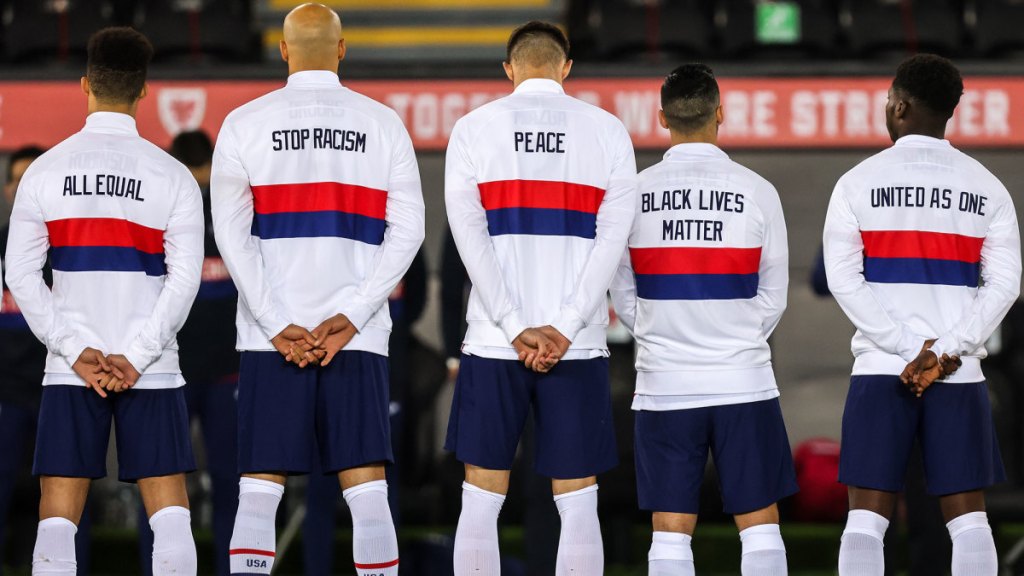
This current crop of American talent further distinguished themselves during the Black Lives Matter protests following the murder of George Floyd. USMNT stars such as Weston McKennie, Timmy Weah, and Christian Pulisic appeared in a June 2020 video titled “Enough is Enough,” in which they expressed outrage over police brutality. McKennie was particularly active in the BLM movement wearing a “Justice For George Floyd” armband during his Bundesliga match in Germany with Schalke 04 and using his social media to share resources by which his fans could support the movement. During a 2021 friendly against Trinidad & Tobago, members of the team and coaching staff openly wore t-shirts inscribed with the message “Be The Change” on the front and “Black Lives Still Matter” on the back. Goalkeeper Zach Steffen launched the VOYCENOW foundation to raise awareness for challenges experienced by youth of color and to provide marginalized communities with educational resources.
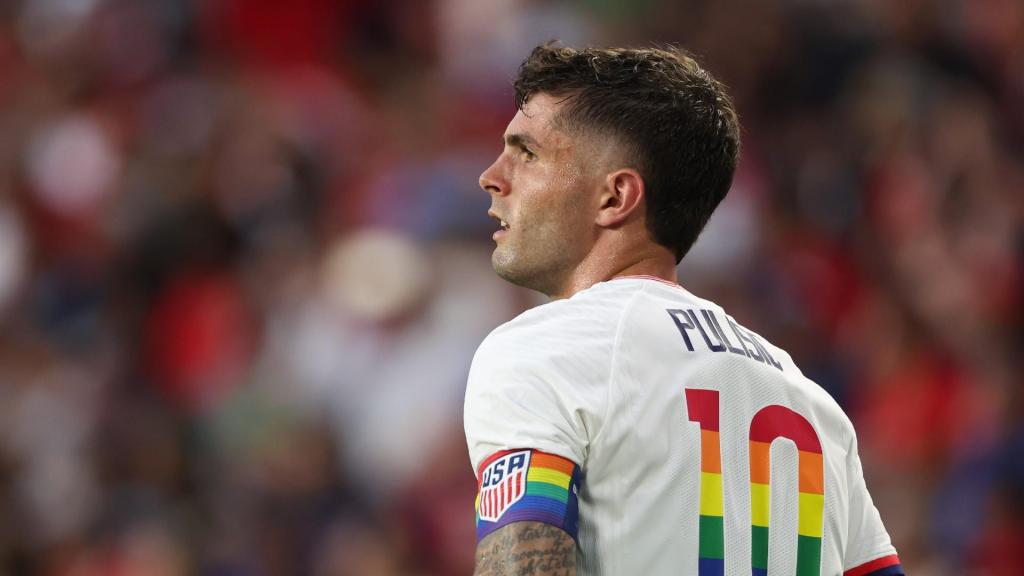
Finally, in addition to social stances, many USMNT players have embraced philanthropy by launching their own foundations or working as ambassadors for important organizations. Some highlights include Christian Pulisic who opened two “Stomping Ground” sports facilities in Pennsylvania and Los Angeles designed to provide local underserved youth access to soccer and recreational facilities, mentorship programs, and life skills workshops. Defender Chris Richards serves as an ambassador for the Soccer Forward Foundation which aims to expand access to soccer, promote physical and mental well-being, strengthen local community connections to the sport, and advance equity for women and girls in soccer. A member of the 2022 World Cup squad, Kellyn Acosta, has been particularly active in philanthropy with the launch of his foundation which aims to make soccer more accessible for disadvantaged and disabled youth.
Despite recent struggles, this group of players has the character to step up and perform with passion and grit during what will be the biggest tournament of their lives. Many of them built this sense of passion and drive from their varied and unique upbringings, which leads to my next point. . .
Reason 2: The USMNT is a microcosm of the diversity that makes America actually great.
The two goalscorers in the recent US win over Japan, Alejandro Zendejas and Folarin Balogun, speak to the uniquely international complexion of the USMNT and the true diversity of the United States. Zendejas was born in Ciudad Juarez, Mexico and raised in Texas. Balogun, meanwhile, was born in New York City to Nigerian parents but was raised in England. He played for both England and the United States at the youth level, and had considered representing Nigeria before deciding to play for the USMNT.
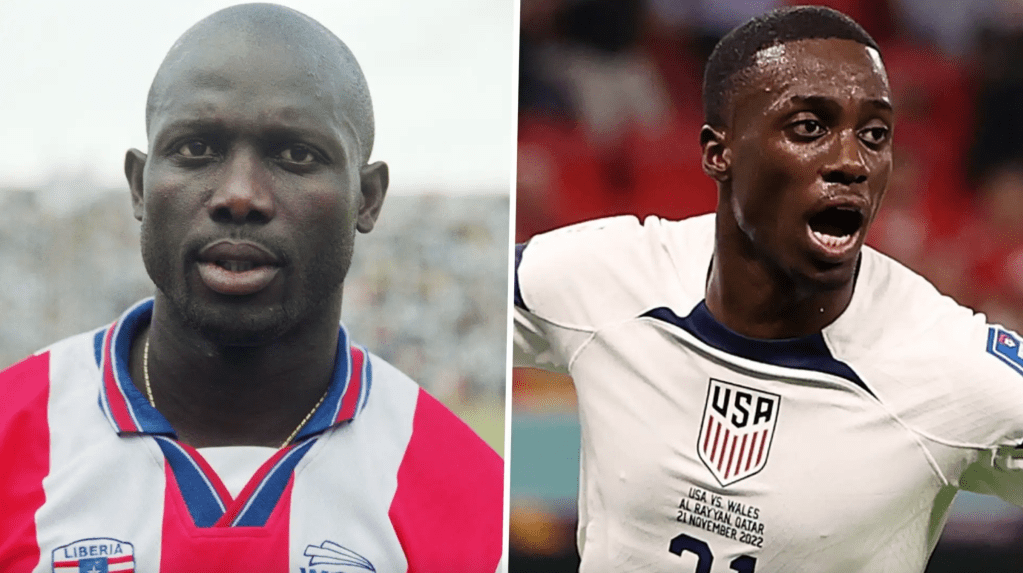
Regarding their mixed backgrounds on the national team, Zendejas and Balogun are not alone. Of the 26 players in the 2024 Copa America squad, 17 were eligible to play for other countries before committing to the USMNT either by being born and/or raised outside of the United States, having dual citizenship, or being born to immigrant parents or grandparents. The USA’s star left-back, Antonee “Jedi” Robinson, was born and raised in England with an American father, much like his right-back counterpart, Sergiño Dest, who was born and raised in the Netherlands to a Surinamese-American father. Timmy Weah’s family history is particularly fascinating in that he, like Balogun, was born in Brooklyn, NY. However, prior to declaring for the United States, Weah would have been eligible to represent France, Jamaica, and Liberia. The Liberian connection would have been particularly strong because his father George Weah not only played for the Liberian national team, but also served as the President of Liberia from 2018 to 2024. Even Hershey, Pennsylvania’s Pulisic, sometimes referred to as “Captain America,” was only able to move to Borussia Dortmund’s academy in Germany as a teenager due to his Croatian passport.
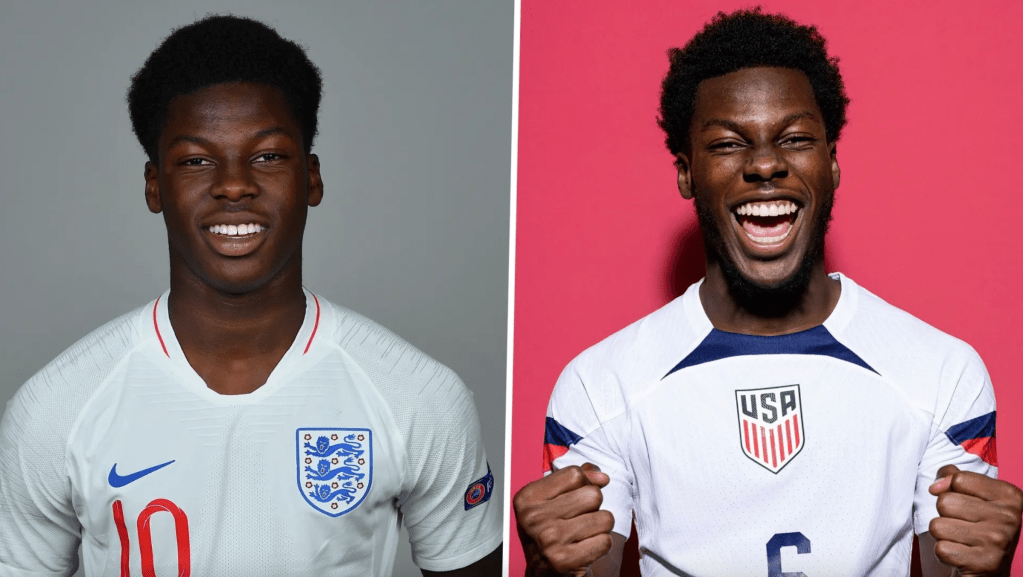
On the surface, it can be easy to lazily question the “American-ness” of this team. However, this team much more accurately represents the diverse characteristics of the United States. According to the American Immigration Council and the Pew Research Center, as of 2025 there are about 51.9 million immigrants living in the United States (approximately half of whom are naturalized U.S. citizens), while 38.3 million Americans—and one in four children under 18—have at least one immigrant parent. Since its inception, the United States has experienced wave after wave of migrants from around the world who have built its culture. Though our national team has a roster with a higher immigrant percentage than the national average, this stems from the fact that soccer has historically been better embraced by immigrant communities and shunned by ‘white America’ until very recently. Unless one’s lineage is 100% indigenous, almost all Americans come from an immigrant background to some extent.
It can be easy to get into a never-ending discussion over “what it means to be an American”; The more interesting focus is on those who had the option of playing for other countries but chose to represent the United States. FIFA’s regulations on national eligibility are a labyrinth of confusing contradictions, allegiance switches, and gray areas. But the important rule to know is that, generally speaking, one is able to play for the national team of their country of birth, the country of birth of at least one parent or grandparent, or country where one resided for at least five years. For example, in an alternate universe where I became a world class footballer instead of failing to make the final roster of my Division III university team, I would have been eligible to represent the United States, Romania (my parents), and Greece (grandparents on my father’s side) in international competition. For many dual-national footballers, this choice presents an excruciating dilemma regarding which country best represents them. Though there have been some players that may have picked the nation that they believed would have given them the best opportunity to succeed on the international stage, many have had to deeply soul-search to make this decision.
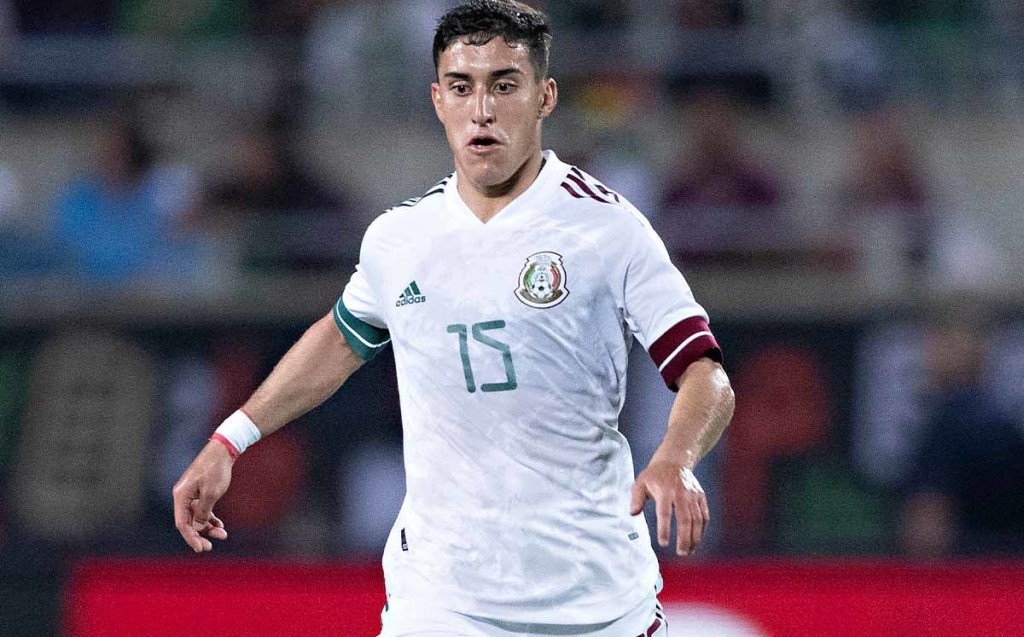
This is particularly true for the many Mexican-Americans who have played for Team USA. The United States and Mexico have had a long and deep-seated rivalry as well that blends issues of cultural identity, politics, and regional power. The two nations have frequently competed to convince Mexican-American footballers to represent one nation over the other. On one hand, many Mexican-American children grew up supporting El Tri, and choosing to represent Mexico can be seen as embracing their roots and their families. On the other hand, choosing to put on the U.S. jersey can be seen to represent the realization of an American dream that their families had hoped to achieve for them when they came to the United States, and all the sacrifices that came with it. Recent USMNT squads have featured a number of prominent players of Mexican heritage such as Ricardo Pepi, the aforementioned Alejandro Zendejas, and Diego Luna who had to make a pressure-filled decision. Pepi has since spoken about supporting Mexico as a child and his family who had hoped that he might one day play for their home nation, and Zendejas had gone as far as playing for Mexico in two exhibition matches prior to controversially switching his allegiance to the United States. Given not only the sporting rivalry but also the well-documented political tensions between the U.S. and Mexico—particularly in 2025—the decision over which national team to represent is complex and layered. As the line from the 1997 film Selena goes: “Being a Mexican American is tough … we gotta prove to the Mexicans how Mexican we are, and we gotta prove to the Americans how American we are. We gotta be more Mexican than the Mexicans and more American than the Americans. It’s exhausting.”
Choosing to represent the Red, White, and Blue is the bold decision that these dual-nationals make. Therefore, it is important for American fans to applaud, celebrate, and support those who have. In a way, there is an added sense of allegiance for dual-nationals that play for the USMNT because they had to actively opt-in and choose the United States, despite strong cultural ties elsewhere. It is one thing to be born into a nation; it is another thing to choose it. Many players had the option of playing for either a more accomplished national team like England or Germany, or for a nation with which they may feel more culturally connected, such as England for Balogun and Robinson. However, they chose to embrace the United States with all its merits and all its flaws in the same way many hundreds of millions of migrants over the years chose to make a personal contribution to this experiment in prosperity and multiculturalism. For those who feel conflicted about representing the United States in the current political climate—particularly given the Trump administration’s policies and treatment of marginalized communities—I would like to raise reason number three. . .
Reason 3: The USMNT represents America as it actually is — the great and the ugly.
At the pinnacle of the USMNT’s success in the mid-2000s, which saw the US reach 4th in the world according to FIFA’s World Rankings, the squad had the reputation of not having any real global superstars but being able to play a hard-nosed, organized and pragmatic style of soccer that grinded out results against some of the best nations in the world. They could be seen as a team that embodied a gritty, resilient, and hard-working American ethos which in many ways symbolized the American optimism of the 90s and unity of the post-9/11 years. Fast-forward to the present, many consider the current crop of players to be the golden generation of American soccer. It is filled with world-class talent that has featured for some of the best European clubs in the world such as Barcelona, Juventus, Chelsea, and AC Milan. Yet many will tell you how something has felt “off” about not only the team, but also the direction of soccer in the country. The recent struggles of the national team and the antics of certain team members have left many feeling pessimistic about the team’s prospects for the upcoming summer. Many fans worry that the USMNT is going to squander their greatest opportunity to accelerate the steady progress of the world’s game in the United States.
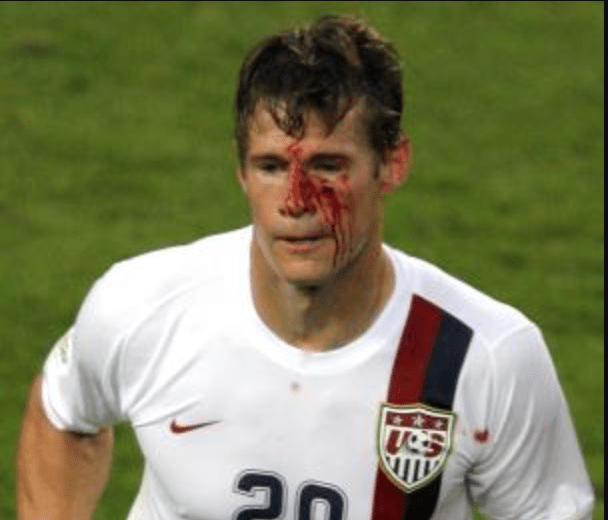
This is not too dissimilar to the general feeling of malaise and hopelessness that many progressives feel about the current state of the United States. From a hyper-capitalist culture that contributes to an enormous wealth gap, layoffs, exploitation, and inflation to the rise of prejudiced and xenophobic policies and the reversal of democratic rule of law, many are disturbed with the direction of the country and pessimistic app. As Americans navigate these challenges, many feel that they don’t have leaders that represent them. They feel forced to choose between the party of xenophobia and radical hatred versus the party of a tired, outdated status quo devoid of new ideas and disconnected from the needs of everyday Americans. Maury Giles, the CEO of Braver Angels which champions cross-partisan cooperation, has personified the United States as “someone who is feeling lost, confused, or beat up … or uncertain of what to do, and looking around and saying this isn’t right, this isn’t the way.” It appears that, for how polarized the American political landscape is, we can agree on one thing: The current status quo is not working; we’re struggling.
In many ways, this team represents who we actually are — the great and the ugly. The USMNT has a habit of representing the qualities of American culture as well as its challenges. When this team succeeds, it demonstrates a uniquely American flavor of grit, resilience, and a shining example of American diversity propelling the nation forward. When it struggles it reflects the challenges of working together, failures to reconcile different ideas on how to move forward, and frustrations over a lack of progress. The US team in particular has long struggled to merge a variety of footballing philosophies from different cultures into one coherent style of play which can be seen as emblematic of how we strain to identify a unique, concrete “American” culture in a nation that was designed to be a “melting pot” of so many cultures and ideals.

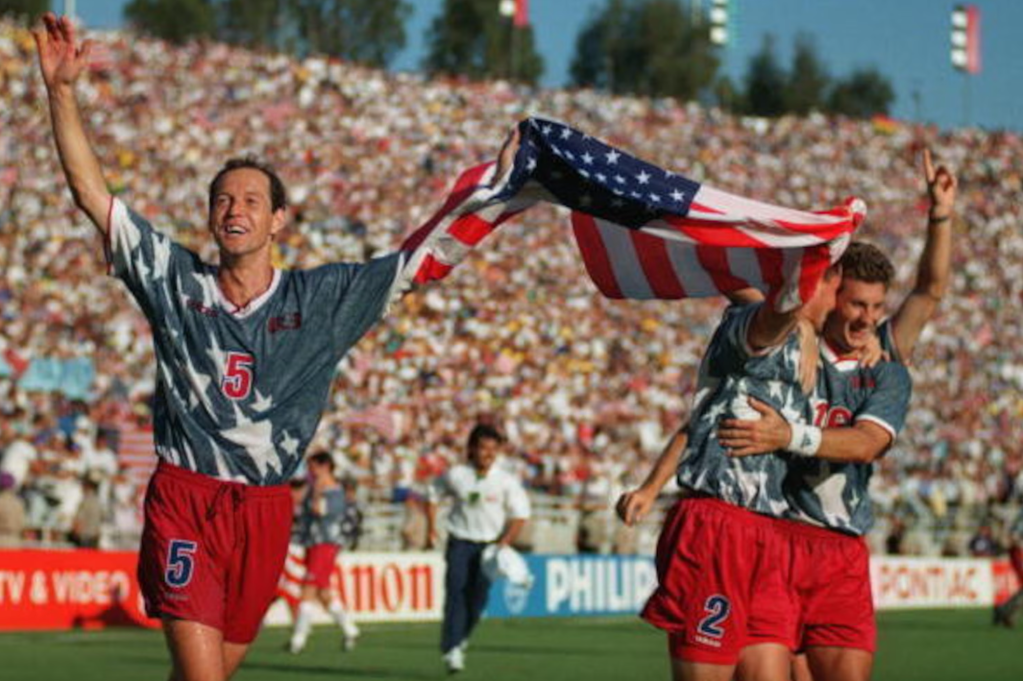
Therefore, it is crucial that this team succeeds. Their success would be a testament to an America that functions better when diversity is celebrated and not vilified. It will not be comfortable. We will not always agree with or understand each other’s methods or philosophies. This team will not necessarily get along. Through a number of recent podcast appearances, USMNT legends from many of the best U.S. squads in the 1990s and 2000s described locker rooms that were dysfunctional and full of clashing characters, to put it lightly. Yet more often than not, they found ways to succeed together on the field. If this team does well at a home World Cup, it will go a long way toward emphasizing a crucial aspect of the American character. It sends a message that, despite our differences, if we can work toward a common goal, then many of our biggest issues can be ameliorated. As three-time World Cup goalkeeper Tony Meola stated in an interview when talking about the national team and the U.S. as a whole, “I don’t think we are in a position to not go together in our country. . . . We can do more good together than we can do being divided going different ways.”
This is not just a collection of overly idealistic clichés, it is backed by many scientists that study national social cohesion. In writing about the conception of national myths and collective national identities, Norwegian theologian and sociologist Dag Thorkhildson wrote about the crucial role that sport can play in highlighting and strengthening national identity, because it can offer a sense of group identification, integration, and acceptance of a new set of national myths and norms. In other words, if a group of players from a nation of varied cultural backgrounds can work toward a common goal of winning games on the world stage, it can set a larger precedent. It imprints a symbolic template for a country that, despite ideological and cultural differences, is more successful due to its diversity, and not in spite of it.
Stoppage Time
As Americans lament the severity of our currently hyper-polarized sociopolitical environment, many wonder what is missing from modern discourse that could help heal some of our deepest wounds. As I reflect on one of the greatest victories of progressives in America to date—the election of the United States’ first African American President—I am reminded of a key component of his campaign that was perhaps unappreciated at the time: unity. In his famous “A More Perfect Union” speech from his 2008 campaign, then–U.S. Senator Barack Obama directly addressed issues of racial prejudice, the brutal history of oppression against people of color, and the threats posed by resentment and anger that led to what he referred to as a “racial stalemate.” He called for reconciliation, progress, and unity as America pushed forward into the 21st century. Indeed, unity has continued to be an overarching theme of his messaging ever since, and the need for unifying national symbols has never been more crucial.
It would be extraordinarily unfair to pin the hopes of national cooperation on the shoulders of 26 young athletes this summer. The pressure of engendering a political climate of unity and cooperation should only be placed on the shoulders of our elected officials. However, having a whole country support this team through all the trials and tribulations it will face from now until the end of the tournament would present a framework and teachable moment for how Americans of all varieties can function together. If the team performs well at the World Cup, it could at least provide a symbol that Americans can not only function together but succeed when uniting to work toward shared goals. That is the beauty of this team.
In my view, there is no other sport in this country that represents Americans at their strongest, weakest, and rawest—from the highs of scrappy individuals from different backgrounds punching above their weight, to the lows of infighting and complacency that sabotage progress. This team has never been pretty; it struggles to sew together a coherent identity, and it has never fully gotten along with its fans, its federation, or even itself. It has surprised us; it has disappointed us; it has profoundly perplexed us. Yet, due to its raw reflection of the realities that make up the United States, the successes that it does achieve more powerfully emphasize the American collective spirit than any other group of athletes. A deep run in 2026 with a country supporting it will provide proof, at least to some fans, that there is hope for the current state of American society. For that reason alone, it is crucial that all Americans—including progressives—back this team at the 2026 FIFA World Cup.

 Explaining Offsides
Leave a comment